Blockchain Ledger Explained
Think of a blockchain ledger like this: you and your friends keep track of who owes what after splitting bills. Usually, one person maintains the list. But what if they lose it, conveniently 'forget' they owe $20, or just write down whatever benefits them?
A blockchain ledger is just a record book that everyone has a copy of. Every single transaction gets written down, and then that page gets locked - like, permanently locked. You can't go back and erase it or change it later.
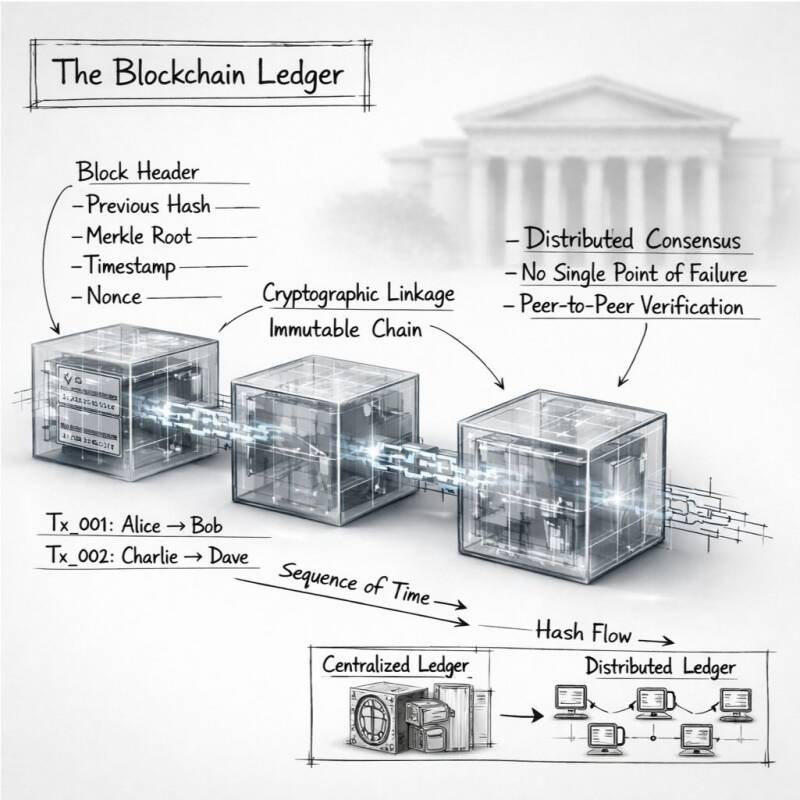
So how does this "locking" actually work? Each page (or "block") has a header with four key pieces:
Previous Hash – Think of it like a wax seal from the previous page. Each page references the one before it, so you can't slip a fake page in the middle without everyone noticing.
Merkle Root – This is a condensed fingerprint of all the transactions on that page. It's like summarizing "Alice paid Bob, Charlie paid Dave" into one unique code.
Timestamp – Just when the page was created. Pretty straightforward.
Nonce – A random number miners mess with to solve a puzzle. It's like trying different combinations on a lock until it clicks open.
Cryptographic Linkage means each block connects to the next using math that's basically impossible to fake. Change one thing in an old block? The whole chain breaks.
Immutable Chain – Once something's written, it's permanent. You can't white-out a transaction from three months ago without everyone's copy showing the tampering.
This is the critical piece:: this locked chain doesn't sit in one place. Thousands of computers hold identical copies. That's Distributed Consensus - instead of one bank holding the records (centralized ledger), everyone has the same ledger (distributed).
No Single Point of Failure – If one computer crashes or gets hacked, who cares? There are 10,000 others with the same info.
Peer-to-Peer Verification – These computers constantly check each other's work. "Hey, did Alice really send Bob 5 coins?" They vote on it. Majority rules. No referee needed.
The visual shows this perfectly: centralized is one vault that could get robbed or corrupted. Distributed is everyone having the same record book. You'd need to hack the majority of computers simultaneously to cheat the system – virtually impossible.
Hence blockchain isn't magic. It's just a really clever way of keeping records where trust comes from transparency and math, not from some authority figure saying "trust me."